




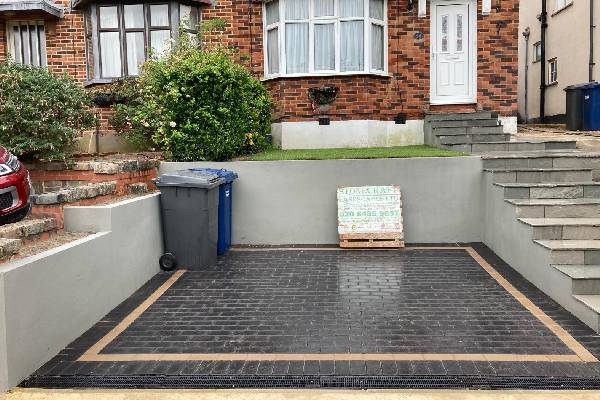
If you’re planning a new driveway in North London, the surface you pick matters, but the contractor you choose matters even more. A well-built drive should look great on day one and still feel solid years later, with no sinking, puddles, wobbly edging, or weeds appearing through the middle.
And in North London, there are a few extra realities: tighter frontage space, mixed soil conditions, older properties, and plenty of wet weather to test drainage. (For example, the Met Office’s Northolt long-term averages show around 808mm of rainfall a year in the 1991–2020 period.)
So how do you find someon e you can trust with your home?
Below is a practical, homeowner-friendly guide to choosing the right driveway contractor in North London.
1) Start with your “real life” brief (not just a Pinterest photo)
Before you even ask for quotes, get clear on what the driveway must do for your household:
- How many cars now (and likely next year)?
- Do you need space to turn, or is reversing out OK?
- Is the slope awkward? Do you get standing water after rain?
- Do you need a bin area, bike storage, or a safer walkway to the front door?
- Any privacy/security add-ons like gates, walls, or fencing?
A good contractor will ask these questions early. If they don’t, that’s a sign they’re quoting “a surface”, not designing a driveway that fits your home.
2) Know the drainage and planning basics (because mistakes can be expensive)
Many driveway problems in North London come down to water. If water has nowhere to go, it sits on the drive, freezes in winter, or runs towards the property.
Two key rules to be aware of:
- You usually won’t need planning permission for a new/replacement driveway if it uses permeable surfacing (or drains to a permeable area like a lawn/border).
- If you’re covering more than 5 square metres with an impermeable surface and there’s no provision for water to drain to a permeable area, planning permission may be required.
A reliable driveway contractor in North London should talk you through drainage and surface water management as part of the quote, not as an afterthought.
3) Look for credibility you can verify (not just a nice logo)
Sadly, home improvement complaints are common. Citizens Advice reported 36,534 home maintenance and improvement complaints (01/07/24–30/06/25), and 14.3% involved scams or rogue traders.
So be a bit “boring” here (it saves money later):
Ask for:
- Proof of public liability insurance
- A clear explanation of guarantees/warranties
- A written quote with materials, excavation, waste removal, drainage, and a realistic timeline
- Recent local work you can view (even a quick drive-by is helpful)
If they mention trade schemes or memberships, verify them on the official register. For example, TrustMark describes itself as a Government Endorsed Quality Scheme for work carried out in or around the home.
4) Ask how they build the base (this is where cheap quotes cut corners)
Driveways fail because of what’s underneath, not because of the block colour.
When comparing driveway contractors in North London, listen for clear detail about the build-up:
- Excavation depth (how far they dig down)
- Sub-base type (e.g., MOT Type 1/hardcore) and how it’s compacted
- Edging restraints (to stop blocks drifting)
- Drainage falls (so water flows the right way)
- Weed control layers (fabric where appropriate)
For example, Stonecraft Landscapes describes a process including digging out to around 12 inches, building a compacted sub-base, using weed-restraining fabric, and screeding for correct water and drainage levels. (This is the kind of detail you want from any contractor you’re considering.)
If someone says, “We’ll just lay it on sand and it’ll be fine,” treat that as a red flag.
5) Compare quotes properly (apples to apples)
A driveway quote can look cheap simply because it’s missing big items.
When you get 2–3 quotes, check whether each includes:
- Excavation depth and removal of spoil/waste
- Sub-base material and compaction method
- Drainage solution (channels, soakaway, permeable design)
- Edging/borders
- The finish (block paving, resin-bound, tarmac, concrete, gravel)
- Aftercare (sealing guidance, maintenance advice)
Stonecraft’s driveway service page lists common driveway types homeowners choose, including block paving, tarmac, concrete, gravel, resin-bound, and cobblestone.
6) Watch out for payment pressure (especially big deposits)
A trustworthy contractor won’t rush you into paying large sums before work starts.
As one example of a consumer-friendly approach, Stonecraft states no deposit or payment until completion, plus being fully insured and guaranteed.
You don’t need every contractor to match that exact policy, but you do want:
- Clear staged payments (if used)
- Written scope
- No “cash today” pressure
- A proper receipt trail
7) Use these questions on your site visit (copy/paste checklist)
Here are simple questions that quickly reveal who’s professional:
- What depth will you excavate to, and why?
- What sub-base will you use, and how will it be compacted?
- How will you handle drainage and falls?
- How do you stop edges from spreading over time?
- What happens if we find soft ground or old foundations? (Do they explain options and costs?)
- Who removes the waste and how is it disposed of?
- What guarantee do you provide, and what does it cover?
- What’s the realistic timeline, and how will you keep the site tidy/safe?
Good answers sound calm, specific, and routine. Vague answers usually mean shortcuts.
8) Quick “red flags” to avoid (even if the price is tempting)
Be cautious if you notice any of these:
- Quote is verbal only or just a one-line text
- They refuse to show insurance details
- They won’t specify excavation depth or drainage approach
- They pressure you to decide “today only”
- Reviews seem generic, repeated, or don’t match the business name
- They can “start tomorrow” with no planning, no survey, no materials listed
A final word for homeowners searching “driveways North London”
A driveway is a daily-use surface. You walk on it, park on it, wheel bins on it, and in London weather it gets tested constantly. Paying a little more for proper preparation (base, drainage, edging, compaction) is often what prevents the bigger cost of ripping it up and doing it twice.
If you want a simple way to shortlist contractors, use this rule:
Choose the team that explains the build-up and drainage clearly, puts everything in writing, and makes you feel informed (not rushed).
Stonecraft Landscapes is a North London-based, family-run company (Mill Hill) offering driveways, patios, fencing and walls, landscaping and decking across North London, North West London and Middlesex, and they note they can advise on local authority requirements for new driveways and hard-standing areas.
FAQ
Do I need planning permission for a driveway in North London?
Often no, if the driveway is permeable (or drains to a permeable area). But impermeable paving over 5 square metres without proper runoff provision may need permission.
What’s the most common reason a driveway fails?
Poor ground preparation: shallow excavation, weak sub-base, poor compaction, and weak edging are the usual culprits.
How many quotes should I get?
Two to three is usually enough. The goal is not the cheapest number, but the clearest scope and best long-term value.