




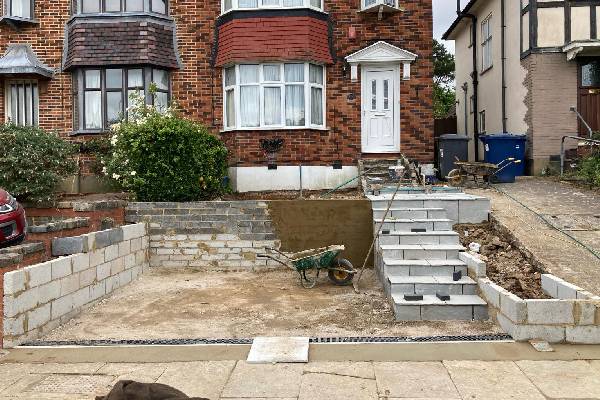
North London’s terrain isn’t flat everywhere, and a fair number of gardens across areas like Mill Hill, Totteridge, and the wider Barnet and Harrow districts sit on some kind of gradient. A garden with an awkward slope often feels underused, difficult to mow, tricky to furnish, or simply not somewhere anyone wants to spend time. Sorting that out usually comes down to two tools: garden walls and steps, sometimes used together, sometimes one or the other.
Deciding which applies, and where, is really a question about how the ground actually behaves rather than a matter of preference.
What garden walls and steps each do
A garden wall holds back soil, creating a level change between two areas at different heights. It turns a slope into a series of flat, usable terraces. Steps, on the other hand, don’t hold anything back; they simply provide a safe, comfortable way to move between two levels, whether that level change was created by a garden wall or is simply the natural shape of the garden.
In practice, most sloping gardens end up using both: garden walls to create flat, usable zones, and steps to connect them.
When a slope needs a garden wall
If a slope is steep enough that it’s genuinely difficult to use, whether that means mowing it safely, positioning furniture, or planting beds that won’t wash out in heavy rain, terracing with a garden wall is usually what makes the space workable. A garden wall is also the right call where you want a clearly defined flat area, for example a patio or seating area, cut into a slope rather than perched awkwardly on it.
Smaller level changes, even just a foot or two, are often worth garden too, since an unretained slope that steep is still difficult to plant or walk across safely.
When steps alone are enough
If the garden already has one or two natural, gentle level changes that don’t need to be flattened, for example moving from a raised patio down to a lower lawn, steps alone might be all that’s needed to connect the two spaces safely. This is common where the upper and lower areas are already reasonably usable on their own, and the goal is really just safe, comfortable access between them rather than reshaping the ground itself.
Steps are also considerably less involved to install than a garden wall, since they don’t need to resist ongoing soil pressure in the same way, which makes them the simpler option wherever a full retaining structure genuinely isn’t needed.
Working out what your garden needs
A few things tend to determine the right approach:
- How steep is the slope, realistically? A gentle rise across a long garden behaves very differently to a sharp drop over a short distance. The steeper and more abrupt the change, the more likely it needs proper retaining rather than just planting to hold the ground.
- What do you actually want to do with the space? A garden meant for entertaining generally benefits from flat, retained terraces. A garden that’s mainly planting and greenery might only need steps between naturally sloping beds.
- What’s the soil doing on the slope currently? Bare or thinly planted slopes are more prone to erosion and soil movement in heavy rain, which is a sign that retaining, rather than just steps, is probably needed to stabilise the area long-term.
- How is the garden used day to day? Families with young children or anyone with mobility considerations generally benefit from fewer, gentler level changes with wider, well-lit steps, rather than a series of steep drops.
Local considerations for North London gardens
A lot of North London plots, particularly older terraced properties, are relatively narrow and long, which means a slope often runs the length of the garden rather than across it. That layout tends to favour a series of smaller retained terraces rather than one large wall, since it fits the shape of the plot more naturally and avoids one very tall structure.
London Clay, which underlies much of the area, holds water and expands and contracts with moisture changes more than sandier soils. Any garden wall built into it needs proper drainage behind it to manage that pressure over time, and this is worth factoring into the design from the outset rather than adding later.
For anything beyond a low retaining edge, it’s worth checking with the local council whether the height of a proposed wall needs planning permission, since this can depend on the specific site and its proximity to boundaries.
Practical takeaways
Before deciding on an approach, it helps to walk the slope at different points and note where it feels genuinely difficult to use versus where it’s simply uneven but manageable. It’s also worth thinking honestly about how the space will actually be used day to day, since that has more bearing on the right layout than the slope measurement alone. If the ground is currently bare or eroding in places, that’s a sign worth mentioning to whoever assesses the garden, since it points toward retaining being needed rather than steps alone.
When professional help makes sense
Any retaining structure holding back a meaningful amount of soil needs proper footings and drainage to be safe over the long term, and this isn’t really a project to take on without experience. Steps on a gentler slope are a more straightforward undertaking, but getting the rise and depth right still matters for safety and comfort, particularly for anyone less steady on their feet.
If your garden has a slope that’s never quite worked, Stonecraft Landscapes can take a look at the site and talk through whether garden walls, steps, or a combination would actually solve it.