




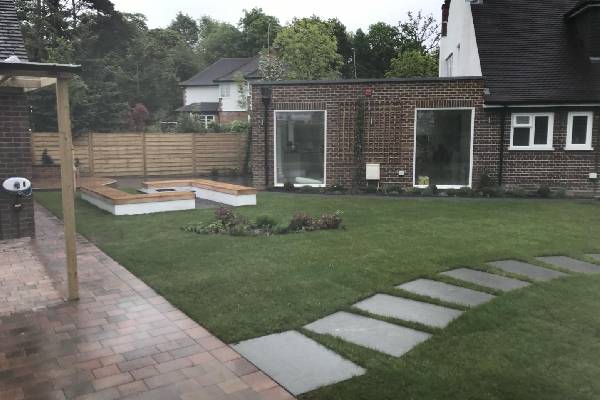
It’s a frustrating situation: you’ve had work done on the garden, new lawn, new beds, maybe a new patio, and yet after rain, parts of it still stay soggy for days. Sometimes it’s a spot near a fence line that never dries out. Sometimes it’s the whole lower half of the garden. Either way, if landscaping work hasn’t fixed the waterlogging, the underlying drainage almost certainly hasn’t been addressed, even if everything above ground now looks tidy.
This is one of the more common issues we get called out to look at across North London gardens, and it’s worth understanding what’s actually going on beneath the surface before deciding on a fix.
What causes a garden to stay waterlogged?
Heavy clay soil. Much of North London sits on London Clay, which is dense and drains very slowly compared to sandier or loamier soils. Water that would soak away within hours elsewhere can sit in clay-heavy ground for days. This is a genuine geological feature of the area, not a fault with any particular garden, but it means drainage has to be actively designed for rather than assumed.
Compacted soil. Ground that’s been walked on, driven over, or compacted during building or landscaping work loses the pore space that would normally let water through. This is a common, if unintentional, side effect of construction work in a garden if the soil structure isn’t properly reinstated afterwards.
No outlet for the water. Even well-graded ground needs somewhere for water to actually go, whether that’s a soakaway, a connection to the surface water drainage system, or a permeable area that can absorb it. A garden that’s been landscaped without that outlet in mind will simply move the water around rather than getting rid of it.
Changes in level from neighbouring work. If a neighbouring garden, extension, or driveway has been raised or resurfaced, water that used to spread out can end up draining toward your garden instead, particularly in a row of terraced gardens where levels are closely linked.
Shaded, poorly ventilated corners. Areas that don’t get much sun or airflow, common in narrow London gardens with high fences or overhanging trees, dry out far more slowly than open, sunny areas, which can make an underlying drainage issue more obvious in those spots first.
Why doesn’t general landscaping fix this?
Planting, turfing, and new paving all sit on top of the ground, and none of them change how water moves through the soil beneath. If a garden was landscaped without addressing drainage specifically, whether that means installing a land drain, creating a soakaway, or regrading the ground to fall toward an outlet, the same water problem tends to resurface once the new lawn or beds have settled in.
This is particularly true with new turf, which can initially look like it’s solved the problem simply because it’s absorbing surface water while establishing, only for waterlogging to reappear once the grass and soil beneath have properly settled.
What actually solves persistent waterlogging?
The right fix depends on the scale of the problem and the layout of the garden, but a few approaches are commonly used:
- A French drain or land drain. A perforated pipe laid in a gravel-filled trench, positioned to intercept water in the problem area and carry it to a soakaway or a suitable outlet.
- A soakaway. A below-ground pit filled with rubble or a purpose-built crate system that allows water to disperse gradually into the surrounding soil, useful where there isn’t a nearby drain to connect to.
- Regrading the garden’s fall. In some cases, the ground simply needs to be reshaped so it falls gently toward a drainage point rather than toward the house or a boundary.
- Soil improvement. Breaking up compacted soil and incorporating organic matter or grit can improve how water moves through the top layer, particularly useful alongside one of the drainage measures above rather than as a standalone fix on heavy clay.
Practical takeaways
If you’re dealing with a soggy patch, it’s worth noting exactly where it is, how long it takes to dry out after rain, and whether it’s got worse or stayed the same since any recent work in the garden. That kind of detail makes it much easier to identify whether the issue is localised or part of a wider drainage problem across the plot. It’s also worth checking whether the waterlogged area is near a boundary shared with a neighbouring property, since changes next door can sometimes be a contributing factor.
When professional help makes sense
A patch that’s slow to dry after unusually heavy rain isn’t necessarily a problem on its own, particularly on London Clay. But ground that stays wet for several days after ordinary rainfall, or that’s visibly getting worse, is worth having properly assessed rather than worked around indefinitely. Waterlogged soil affects what will actually grow well in that spot, and if it’s near the house, persistent standing water close to a foundation is worth taking seriously.
If your garden is holding water somewhere it shouldn’t, Stonecraft Landscapes can take a look at what’s happening below ground and put together a plan that actually deals with it rather than just landscaping over the top.