




If you are searching garden fencing cost UK or how much does garden fencing cost in the UK, you are usually trying to answer two questions:
- What is a sensible budget in 2026?
- Which fence style gives the best value for your garden (privacy, security, looks, maintenance)?
The tricky bit is that “a new fence” can mean anything from swapping a couple of panels to rebuilding a full boundary with new posts, gravel boards, concrete, removal, and a gate. So instead of guessing, let’s compare all the common fence types and show the real cost drivers.
A helpful 2026 benchmark is MyBuilder’s updated guide which puts the average cost of a garden fence in the UK at £85 to £180 per metre (installed).
That wide range is normal, because style, height, ground conditions, and access change everything.
Quick answer: average garden fence installation cost UK (2026)
Here are the most useful “starting points” when budgeting:
- Average cost per metre (installed): £85 to £180 per metre (typical UK range).
- Typical 10m boundary: £850 to £1,500 for a standard timber fence.
- Typical 15m boundary: a standard softwood panel fence often lands around £1,250 to £1,500.
- Labour (only): often £250 to £500 per day depending on location and job complexity.
And one more useful reality check: MyJobQuote’s 2026 guide suggests around £110 to £120 per metre for a typical supply-and-fit fence.
Garden fence prices by material (installed, per metre)
If you want the fastest way to compare options, start with material. MyBuilder’s 2026 ranges (installed) are:
| Material | Typical installed cost per metre |
| Softwood timber panels | £50 to £75 |
| Hardwood timber (cedar, larch) | £75 to £110 |
| Composite (wood-plastic) | £85 to £150 |
| Vinyl / PVC | £35 to £70 |
| Chain link | £20 to £40 |
| Metal / wrought iron | £90 to £150 |
If you are comparing quotes, ask whether the contractor is quoting material-only, labour-only, or supply-and-fit. The wording matters more than people expect.
Cost of garden fencing by style (all types compared)
Now let’s get specific. These are the most common fence styles UK homeowners choose, with typical 2026 price guidance.
1) Overlap panels (lap panels)
This is usually the most affordable “standard garden fence” style.
- Panel cost: often £20 to £50 per panel.
- Best for: straight, level boundaries where you want privacy on a budget.
- Watch-outs: it can feel lighter and less rigid than closeboard, especially in exposed areas.
Real-life example:
If your boundary needs about 6 panels (roughly 11m), MyJobQuote’s example shows around £1,060 for standard wooden panels and timber posts.
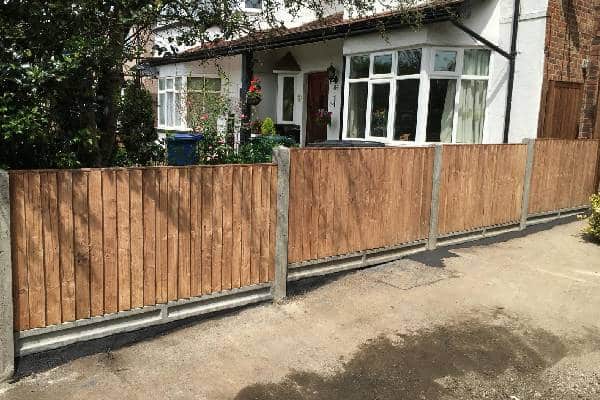
2) Closeboard / feather edge (built on site)
If you want a stronger fence (and something that works better on slopes), closeboard is a common upgrade.
- Typical installed cost (standard softwood): around £50 to £75 per metre.
- Best for: privacy + strength, gardens with uneven ground, wind exposure.
- Watch-outs: higher cost than overlap, and workmanship matters (post spacing, rails, fixing quality).
Checkatrade also lists average costs that can help you sanity-check materials:
- Featherboard/closeboard per panel: often £50 to £70 (average £60).
3) Slatted / horizontal fencing (modern look)
This is the “contemporary London garden” favourite, especially for tidy back gardens and outdoor seating areas.
- Typical installed cost: £50 to £110 per metre, depending on timber type, slat spacing, and finish.
- Best for: modern design, partial privacy (you can control the gap spacing).
- Watch-outs: tighter gaps and wider slats use more material, so costs rise quickly.
4) Picket / palisade fencing (front gardens)
Picket fencing is more about kerb appeal than full privacy.
- Typical installed cost (timber): around £30 to £50 per metre.
- Best for: front boundaries, neat “cottage” look, keeping pets in while staying friendly-looking.
- Watch-outs: if you need privacy, you will need a different style or a mixed design (picket front, solid side/back).
5) Trellis panels (as toppers or dividers)
Trellis is often used to add height without blocking light, or to support climbers.
- Typical cost: often £10 to £30 per trellis panel.
- Best for: extra height above a solid fence, garden zoning, plants.
- Watch-outs: trellis is not a privacy fence by itself unless backed by planting.
6) Composite fencing (low maintenance, higher upfront)
If you want something that looks consistent and avoids regular staining/painting, composite is a strong contender.
- Typical installed cost: £85 to £150 per metre.
- Best for: low maintenance, modern look, long-term value.
- Watch-outs: upfront cost, and you still want good posts and ground preparation.
7) Metal / wrought iron style fencing (security + style)
Often used on front boundaries or as decorative side fencing.
- Typical installed cost: £90 to £150 per metre (can go higher with bespoke work).
- Best for: security without blocking light, smart frontage design.
- Watch-outs: bespoke designs and brickwork piers can shift costs.
8) Chain link (functional, cost-effective)
It’s not the prettiest, but it is practical, especially for side boundaries or larger runs where budget matters.
- Typical installed cost: £20 to £40 per metre.
- Best for: large boundaries, practical separation, pet areas.
- Watch-outs: minimal privacy unless you add screening.
What is included in garden fence installation cost UK quotes?
A proper supply-and-fit quote usually includes:
- Fence panels or boards (or closeboard materials)
- Posts (timber or concrete)
- Post mix / concrete
- Fixings, rails, gravel boards (where used)
- Labour to install
- Setting levels and keeping the run straight
Checkatrade’s cost guide gives a simple benchmark for common materials:
- Average panel: £45
- Average post: £25.50
Always ask: Is removal of the old fence included? That is often an extra line item, and it is where quotes can look “cheap” at first glance.
The 7 biggest factors that change your fencing quote
Two gardens with the same length can get very different prices. Here’s why:
- Height (4ft vs 6ft makes a big difference)
- Posts (timber vs concrete posts and gravel boards)
- Ground conditions (roots, rubble, very soft ground)
- Access (terraced houses, narrow side passageways, no rear access)
- Slopes and levels (closeboard adapts better than panels)
- Removal and disposal (old panels, concrete posts, overgrown hedges)
- Finishing (caps, staining, paint, gates, brick piers)
If you are in London, labour and access can push costs towards the higher end. MyBuilder notes city locations can be 20% to 30% more expensive in some cases.
Planning rules: fence height (quick and safe guidance)
Most homeowners do not need planning permission for a typical back garden fence, but height and location matter.
A clear summary from Planning Portal is:
“If the structure is adjacent to a highway (including footpaths), it must not exceed one metre… For all other boundaries… two metres.”
If you are unsure (corner plots, front boundaries, conservation areas), it’s worth checking before you buy materials.
Boundary and neighbour basics (avoid expensive mistakes)
Before replacing a boundary fence, confirm where the boundary is and who is responsible. Even when relationships are good, it avoids confusion later.
Citizens Advice puts it simply:
“The best approach is to talk to your neighbour.”
That one chat can save weeks of stress, especially if you are upgrading height, changing style, or adding trellis.
How to save money without cutting corners
If you want a fence that lasts, the aim is not the cheapest quote. It is the best value per year.
Smart ways to keep costs sensible:
- Replace only the damaged sections if posts are still solid
- Use overlap panels for long, straightforward runs and upgrade only key areas (near patio, seating, side return)
- Choose good posts (weak posts are the fastest failure point)
- Keep access clear on install day (saves labour time)
- Consider a mixed design: solid fence for privacy, trellis topper for height and light
Local note: fencing and walls in North London, North West London and Middlesex
At Stonecraft Landscapes, fencing is usually part of a wider “garden upgrade” plan, so we often combine fencing with patios, paths, drainage and planting. Our Fencing & Walls service covers new builds, refurbishments, repairs and a wide range of materials.
For trust and peace of mind, Stonecraft also states they are fully insured and guaranteed, and list approvals/recommendations including TrustMark, Federation of Master Builders (FMB), and Local Authority Building Control (LABC).