




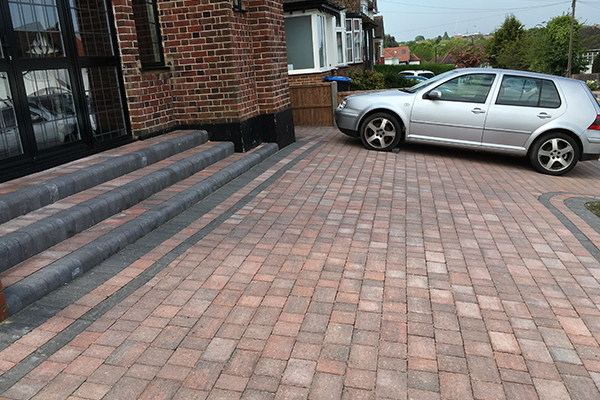
Home EV charging is quickly becoming a “must-have” feature, especially in London where parking is tight and public charging can be inconvenient or expensive. But here’s what many homeowners miss at first: your charger isn’t just an electrical add-on. It becomes part of your driveway’s daily layout, drainage, safety, and even planning considerations.
And in London, weather plays a role too. Heathrow’s long-term average shows 111.66 days per year with at least 1mm of rain (1991–2020), so water management and slip risk matter more than you might think.
Below is a simple, practical guide to what EV charging means for driveway design in London, written for real homes (terraces, semis, tight frontages, side access routes).
1) Treat it as one project, not two separate jobs
The smoothest installs happen when the driveway contractor and EV charger installer coordinate early. Why?
- Charger installers care about cable routes, load, and safe mounting.
- Driveway contractors care about levels, sub-base, drainage, and finishes.
- If they don’t talk, you risk a “new driveway that needs digging up again” to bury a cable.
Best approach: if you’re building or redoing a driveway, ask for ducting/conduit to be installed during groundworks so the charger cable can be pulled through later without breaking up paving.
2) Charger location: the everyday usability test
A charger can be technically “installed” almost anywhere, but a good design is about daily use.
Think about your parking position
Different EVs have charge ports in different places, so the key is: where will the car sit most often?
- If you reverse onto the drive, will the charge port end up near the house wall?
- If you park nose-in, will the cable need to cross a walkway or stretch around the car?
A small shift in driveway layout (even 30–50cm) can turn charging from “awkward” into “easy”.
Keep the cable off walkways
In London front gardens, walkways are usually shared with bins, pushchairs, and deliveries. Aim for a design where the cable:
- runs directly to the car, not across steps
- doesn’t become a trip hazard in the dark or rain
3) Groundworks: plan the cable route properly (this is where money is saved)
If your charger is on the front wall and the consumer unit is at the back of the house (common in some properties), cable routing can get tricky. That’s why driveway design matters.
Smart driveway moves during installation
- Install conduit/ducting under the drive before paving is finished
- Leave a draw rope so the electrician can pull the cable through later
- Agree where the cable will surface (near the charger post/wall mount)
This is especially helpful with:
- block paving (easy to lift and relay, but you don’t want to do it twice)
- resin-bound (you really don’t want to cut and patch unless you have to)
- tarmac (cuts can be visible if reinstatement isn’t perfect)
4) Drainage and planning: your driveway surface choice matters more now
London driveways often sit right next to the home, so managing surface water is essential.
Front driveways and permeable surfacing
Planning Portal guidance is clear: you typically don’t need planning permission for a new or replacement driveway if it uses permeable/porous surfacing (or directs water to a permeable area like a border).
The UK government’s guidance also explains methods like permeable surfaces, soakaways and rain gardens to reduce runoff from driveways or other paved areas.
What this means for EV-ready driveways
If you’re already investing in charging at home, it often makes sense to choose a driveway finish that supports drainage:
- Permeable block paving: practical, repairable, and good for access to buried services
- Resin-bound (permeable): neat look, good drainage when installed correctly (key: correct base and falls)
- Porous asphalt: can be a solution in some designs (depends on spec)
Your contractor should be talking about drainage falls and where water will go, not just the surface you can see.
5) Power and charging speed: design for the “normal” home set-up
Most domestic installs are single-phase and fall into the familiar home-charger range. The UK’s residential chargepoints minimum technical specification references standard AC charging equipment output greater than 3.5kW and not greater than 7kW for typical home setups.
Why does that affect driveway design?
- A typical wall-mounted charger needs a sensible mounting point (brick wall or a dedicated post)
- The cable route and distance can affect installation complexity (and cost)
- Some homes may need the installer to consider supply capacity and protection (your electrician will confirm)
Also worth knowing: in Great Britain, smart charge point regulations require certain smart functionality for charge points, so most modern installs are designed to support off-peak and demand management.
That’s great for bills, but it reinforces the point: plan it like proper infrastructure, not an afterthought.
6) Safety and security: small design choices make a big difference
Consider protective bollards (especially on narrow drives)
If the charger is near the parking area, a simple bollard can prevent accidental bumps (and save you from replacing a cracked unit).
Add lighting where the cable will be handled
In winter, you’ll often be plugging in during darkness and rain. A small downlight can reduce slips and trip hazards massively.
If you don’t have a driveway: don’t trail cables across the pavement
This is a growing London issue. London Councils published guidance to help boroughs roll out cross-pavement EV charging solutions as a safer way to avoid trailing cables.
And the UK government has also published guidance on cross-pavement solutions for safe and effective use.
7) Grants and permissions (quick note, because it changes)
If you’re a renter or flat owner with private/allocated parking, the government’s electric vehicle chargepoint grant guidance notes changes from 1 April 2026, including updated grant values and eligibility details.
Even if you don’t qualify, it’s still useful to read because it clarifies how the government defines eligible off-street/allocated parking.
A practical “EV-ready driveway” checklist (use this when getting quotes)
When speaking to driveway contractors (and your charger installer), ask:
- Where will the charger be mounted, and is it protected from bumps?
- What’s the cleanest cable route (and can we add ducting during groundworks)?
- Will the driveway layout keep cables off steps and walkways?
- What surface and drainage design will reduce puddles and slippery patches? (
- If we add a second EV later, can the driveway design cope (space, cable routes, mounting points)?
- Are we in a conservation area or listed building situation where extra permission might apply for external changes? (Planning rules can vary.)
Final thought
A good London driveway is no longer just “somewhere to park”. With EV charging, it becomes part parking bay, part utility zone, part walkway, and part drainage system.
If you design it properly up front (layout + cable route + drainage + safety), home charging becomes effortless… and your driveway still looks clean and intentional.